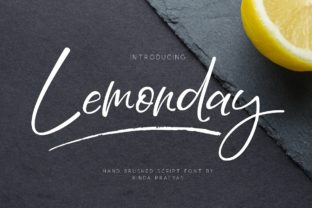
What Is Lemonday and Why It Matters for Designers
Lemonday is a beautiful and authentic handwritten font that brings a unique personality to any design project. Designed with care, it offers a delicate twist that can elevate the visual appeal of creative work. Whether you're working on branding, invitations, or digital content, Lemonday stands out as a versatile typeface that balances charm and readability.
Understanding Lemonday: A Handwritten Font with Character
Lemonday is more than just a font—it's a statement. Created to capture the essence of handwritten script, it features fluid strokes and subtle variations that give each letter a sense of individuality. This makes it ideal for projects where a personal touch is desired without sacrificing clarity.
The font's design draws inspiration from natural handwriting, making it feel both modern and nostalgic. Its elegant curves and soft transitions make it visually engaging, while its legibility ensures it remains functional in various contexts.
Why Designers Might Be Interested in Lemonday
Designers often seek fonts that can convey emotion and personality. Lemonday fits this need perfectly. Its warm and inviting style can help create a connection between the viewer and the message being communicated.
Additionally, Lemonday is well-suited for use in a variety of media, including print and digital formats. It works particularly well in logos, social media posts, and packaging designs, where a handcrafted look can make a significant impact.
Another appealing aspect of Lemonday is its adaptability. It can be used in both large and small sizes, making it suitable for a wide range of applications. This flexibility allows designers to experiment with different layouts and compositions without compromising the font’s integrity.
Benefits of Using Lemonday
One of the key benefits of Lemonday is its ability to add character to otherwise plain text. The font’s handwritten nature can transform a simple headline into something more memorable and visually striking.
It also enhances the overall aesthetic of a design, helping to create a cohesive and professional look. By choosing Lemonday, designers can ensure their work stands out in a crowded market while maintaining a sense of authenticity.
Furthermore, Lemonday is designed with readability in mind. While it has a stylized appearance, it remains easy to read at smaller sizes, which is crucial for web-based content and mobile displays.
Considerations and Tradeoffs
While Lemonday has many strengths, it's important to consider its limitations. For instance, the font may not be the best choice for highly technical or formal documents where a more structured and professional look is required.
Additionally, because Lemonday is a handwritten font, it may not always render consistently across all platforms or devices. Designers should test the font in different environments to ensure it maintains its intended appearance.
There is also the issue of licensing. Depending on how the font is used, certain restrictions may apply. It's essential to review the terms of use carefully to avoid any potential legal issues.
When Lemonday Excels
Lemonday shines in situations where a personal and artistic touch is needed. It is particularly effective in creative fields such as graphic design, branding, and event planning.
For example, it can be used to create eye-catching headlines for blog posts, add a stylish flair to social media graphics, or enhance the visual appeal of wedding invitations and greeting cards. In these cases, the font’s personality helps to convey the intended mood and tone of the project.
It also works well in product packaging, where a handcrafted look can differentiate a brand from its competitors. Lemonday can help create a sense of warmth and approachability, making it an excellent choice for lifestyle brands and boutique businesses.
When Alternatives May Be Better
While Lemonday is a great option in many scenarios, there are situations where alternative fonts might be more appropriate. For instance, in professional or corporate settings, a more traditional serif or sans-serif font may be preferred for its clean and authoritative appearance.
If the goal is to maintain consistency across multiple design elements, a more standardized font could offer greater versatility. Additionally, if the design requires high levels of precision or detail, a font with more uniform lettering might be a better fit.
Designers should also consider the target audience when selecting a font. For younger or more casual audiences, Lemonday’s playful and whimsical style may resonate well. However, for older or more formal audiences, a different approach might be more effective.
How to Decide If Lemonday Is Right for You
Choosing the right font depends on several factors, including the purpose of the design, the target audience, and the overall aesthetic you want to achieve. Lemonday is an excellent choice when you’re looking for a font that adds personality and warmth to your work.
To determine whether Lemonday aligns with your goals, ask yourself a few key questions: Does the font match the tone and style of your project? Is it readable in the context where it will be used? Will it help convey the intended message effectively?
If the answer to these questions is yes, then Lemonday is likely a strong fit. However, if your needs are more formal or require a different visual style, you may want to explore other options.
Ultimately, the decision should be based on what best serves your creative vision and the needs of your audience. Lemonday offers a unique blend of beauty and functionality, making it a valuable tool for designers who want to add a touch of personality to their work.